










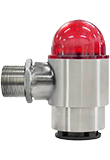

In June 2026, the State Council issued the 15th Five-Year Plan for Urban Renewal (State Council Document No. 12 of 2026), under which China will build or upgrade about 770,000 km of urban underground pipelines during the 15th Five-Year Plan period, with total nationwide investment in pipeline renewal exceeding RMB 5 trillion. By the end of 2025, China had completed roughly 7,700 km of underground utility tunnels, and growing numbers of gas, water supply, drainage, heating, power and communications lines are being consolidated into shared underground space.
Driven by the Ministry of Housing and Urban-Rural Development’s Urban Lifeline Safety Project, prefecture-level cities and above are required to deploy IoT sensing devices on utility tunnels and related facilities, creating a closed loop “from detection and monitoring to early warning and response.” Underground utility tunnels spare roads from repeated “zipper-style” excavation, but they also concentrate multiple hazards in one confined space. Gas monitoring in underground utility tunnels has therefore become the first line of defense for the safety of urban underground lifelines.
Gas Risks in Utility Tunnels: Four Hazards of a Confined Space
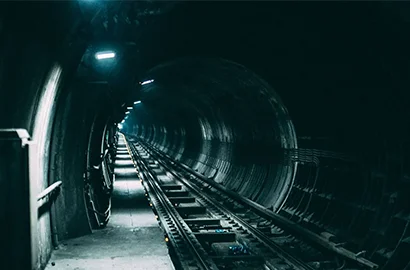
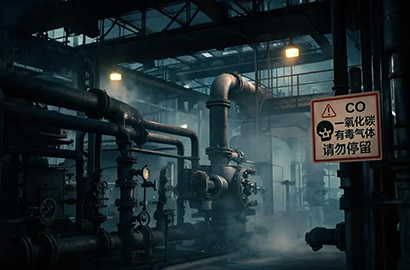
A utility tunnel is a classic confined space, and its gas risks have four defining features. First, it is highly enclosed: natural ventilation within the compartments is weak, so leaked gas can quickly accumulate in low-lying areas or at the top of the tunnel, with concentrations rising to the lower explosive limit (LEL) in a short time. Second, it remains damp year-round, with relative humidity often exceeding 80%, causing electrochemical sensors to drift. Third, multiple pipelines share the same corridor—gas, heating, power and water-supply compartments housed together—so leak sources can compound one another. Fourth, access points are dispersed: ventilation openings, material-feed ports and personnel entrances are both pathways for gases and critical exposure points for inspection staff.
Mandatory Gas Detection List: The “Deadly Quartet”
Based on the types of utilities in the tunnel and confined-space work standards, four gases must be monitored continuously. Together they cover three risk categories—explosion, toxic exposure and oxygen deficiency—and form the minimum detection configuration: omitting any one of them can leave a fatal blind spot.
| Gas | Main Source | Hazard Profile | Alarm Focus |
| Methane CH₄ | Leaks from pipelines in the gas compartment | Flammable and explosive; explosive range 5%–15% | Whether approaching 25% LEL |
| Oxygen O₂ | Poor ventilation; oxygen consumed by corrosion | Oxygen deficiency (<19.5%) or oxygen enrichment (>23.5%) | Whether outside the normal range |
| Hydrogen sulfide H₂S | Decomposition of organic matter in the sewage compartment | Highly toxic; lethal at low concentrations; causes olfactory paralysis | Whether exceeding 10 ppm |
| Carbon monoxide CO | Overheated cables, internal combustion engines | Highly toxic; colorless and odorless; accumulates slowly | Whether exceeding 25 ppm |
Sensor Layout Design: Compartment Classification and Critical Points
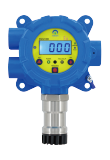
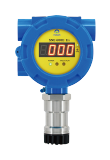
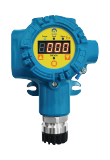
Detector placement should not be an even “sprinkling of pepper”; it should be based on compartment type and located by risk source. Gas compartments should be zoned separately, with detectors placed near release sources such as valves, flanges and joints. Mounting height depends on gas density: methane is lighter than air and should be near the top of the compartment, while liquefied natural gas is heavier than air and should be near the floor. In sewage compartments, the focus is hydrogen sulfide, with detectors at inspection wells, drop manholes and confluence nodes. In power compartments, the focus is carbon monoxide and heat/smoke, with cable intermediate joint wells treated as high-risk points. Sensors are mandatory at ventilation openings, material-feed ports and personnel entrances/exits. Intersections, grade-change points and duct bends can easily become gas dead zones and require denser coverage.
Ventilation Interlock and Remote Monitoring Platform
A single-point alarm only means “the alarm is sounding”; the real line of defense is a closed loop of “detection–alarm–interlock–retest–release.” When the concentration reaches the pre-alarm threshold, the system automatically starts emergency exhaust ventilation and closes fire dampers to prevent cross-compartment spread. At the high-alarm threshold, it interlocks to shut the emergency isolation valves on the corresponding pipeline, triggers audible-visual alarms and pushes a work order to the monitoring center. The interlock may be released only after retesting confirms that the concentration has fallen back. The entire process requires a T90 response time of no more than 30 seconds, with all actions fully traceable.
The remote monitoring platform enables one-screen management, multi-level early warning and closed-loop response. Its four-layer architecture consists of a perception layer (gas, temperature-humidity and level sensors), a transmission layer (industrial fieldbus or 4G/NB-IoT), a platform layer (data aggregation, risk mapping and multi-level alerting), and an application layer (mobile alarms, closed-loop response and data analytics). The smart management platform for about 19 km of utility tunnels at an airport is a typical reference case, integrating environmental monitoring, remote control, alarm handling and data analytics in one system.
O&M and Inspection Regime: Monitoring That Never Sleeps
Periodic calibration — electrochemical sensors every 6–12 months and infrared sensors once a year, so equipment does not drift.
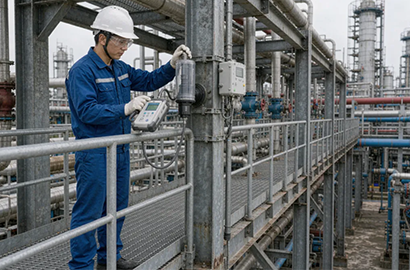
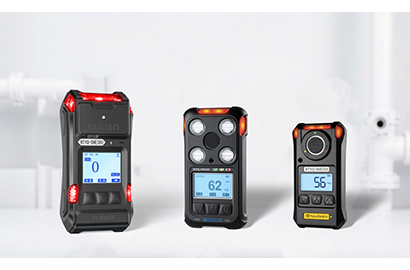
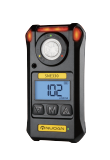
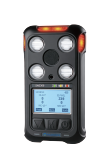
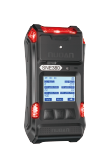
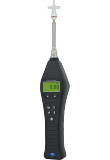
Routine patrols — use handheld pump-drawn detectors to retest blind spots, with particular attention to ventilation openings and personnel entrances/exits.
Periodic review — revisit alarm logs monthly to distinguish real leaks from false alarms.
Regular drills — conduct at least one confined-space emergency drill each year to validate interlocks and evacuation procedures.
Conclusion
Underground utility tunnels are the city’s hidden fabric, and gas monitoring is their nervous system. As RMB 5 trillion in investment moves more pipelines underground, only a monitoring system that can sense, warn and respond makes this urban lifeline truly safe and controllable.