



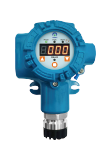
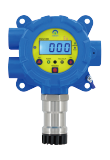
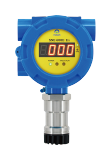
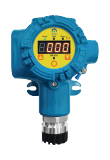



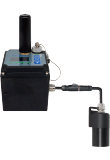


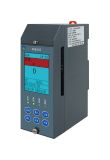


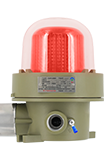
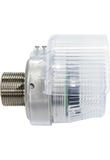
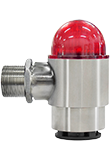

In petrochemicals, power and energy, warehousing and logistics, aerospace, and many other industries, fire is a constant sword of Damocles hanging overhead. As winter arrives, temperatures plummet, air humidity drops, and the environment becomes dry, further exacerbating fire hazards. “Early detection, early warning” makes fire prevention and control a top priority. Flame detectors are precisely the “technological sentinels” in industrial safety systems that defend against fire risks—accurately identifying and rapidly alerting to fire incidents in their earliest stages, buying precious time for evacuation and firefighting. Since different flame detectors employ different technologies, scientific selection is also critical.
When flames burn, they emit optical radiation energy at specific wavelengths, primarily covering three regions: the ultraviolet (UV) region, the visible light region, and the infrared (IR) region. Optical flame detectors do not “see” the shape or color of flames; instead, they use sensors to identify these characteristic spectral signals and then apply algorithms to determine whether a real fire exists. For example, hydrocarbon flames (such as methane and gasoline) emit strong radiation in both the UV and IR regions, while hydrogen flames exhibit unique characteristics in the UV region. Current flame detection technologies include ultraviolet (UV) flame detectors, infrared (IR) flame detectors, and composite detectors (such as UV/IR combination). Infrared (IR) flame detectors, with their multi-band design, can reduce interference from ambient light and offer superior low-temperature performance, maintaining high reliability under dry and cold conditions—which is why they are widely used.
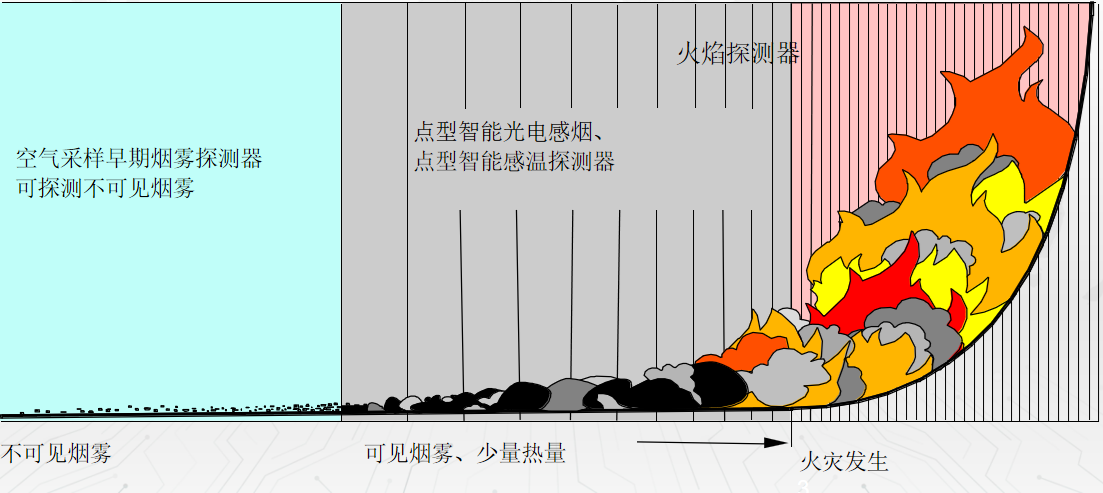
Winter Fire Prevention: Flame Detector Selection Should Target Three Core Requirements
First is interference resistance. Winter brings frequent strong winds, lightning, low temperatures, and frost, making detectors susceptible to false alarms caused by sunlight, rain and snow reflections, and other factors. Second is environmental adaptability. From outdoor environments tens of degrees below zero to high-temperature indoor plant areas, detectors must operate stably under extreme temperature and humidity conditions while offering waterproof and explosion-proof performance to handle complex outdoor operating conditions. Finally, there is detection accuracy. Dry climates allow fires to spread rapidly—especially fires caused by flammable materials such as oil and gas, which can escalate into major incidents within seconds. Detectors must accurately identify and alert to fire incidents in their earliest stages, buying time for response.
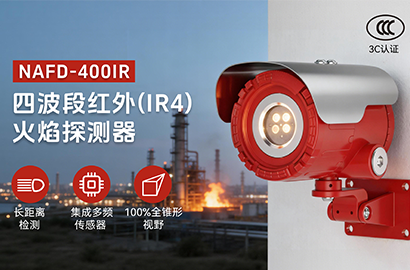
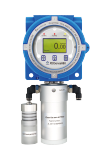
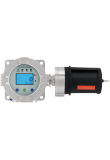
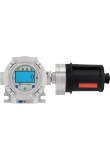
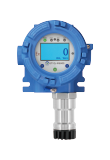
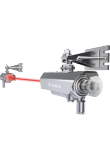
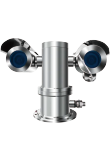
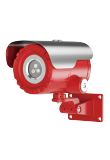
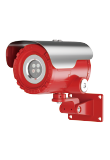
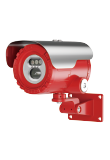
Nuoan Technology’s NAFD-400IR four-band infrared flame detector has become a “hardcore” asset for winter fire prevention, thanks to its precise detection, strong interference resistance, and adaptability to harsh environments. The NAFD-400IR flame detector employs advanced four-infrared sensing technology and a dual-channel infrared sensing structure. By analyzing the synchronicity and ratio relationships of signals across two bands (one reference channel plus three reference channels), it identifies genuine flames. Combined with a 32-bit high-performance microprocessor and advanced mathematical algorithm models, it accurately distinguishes real flames from interference sources such as sunlight, lightning, electric welding, artificial light sources, thermal radiation, electromagnetic interference, and mechanical vibration. Its false-alarm resistance far exceeds that of single-band products, delivering more reliable monitoring in complex winter environments.
For extreme winter weather conditions, the NAFD-400IR four-band infrared flame detector demonstrates exceptional environmental adaptability. Its operating temperature range covers -40°C to +70°C, ensuring stable operation in both severe cold and dry, high-temperature environments. With a waterproof and explosion-proof design, an IP67 protection rating, and an S316 stainless steel housing, it effectively withstands winter rain, snow, and dust intrusion while preventing contamination of the optical window from compromising detection accuracy. Strong environmental adaptability.
In terms of detection performance, the NAFD-400IR four-band infrared flame detector offers a detection range of up to 50 meters, a 90° full-cone field of view, and a response time of under 30 seconds, enabling rapid capture of incipient fires. It supports multiple output signals and can flexibly interface with fire protection systems to achieve integrated alarm-linked fire suppression operations, significantly enhancing fire prevention and control efficiency.
Winter Fire Prevention Campaign, Technology as the Guardian: Winter fire safety is no small matter—every hidden hazard can lead to catastrophic consequences. Selecting flame detectors that are suited to the environment and offer precise, reliable detection is a key measure for enterprises and organizations in fulfilling their fire safety responsibilities. With its professional sensing technology and rigorous quality control, Nuoan Technology’s NAFD-400IR four-band infrared flame detector enables flame detectors to truly serve as “frontline sentinels” in winter fire prevention—safeguarding lives and property through precise detection and fortifying the safety defense line. Making winter safer and warmer.