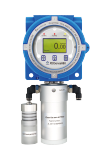


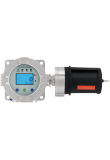
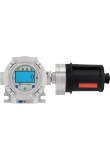
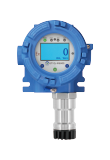


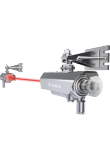
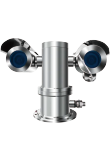
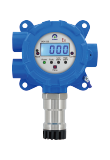
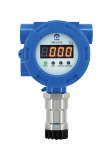



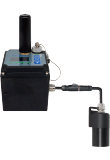


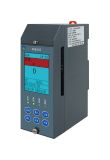
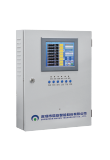
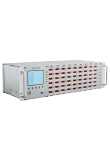

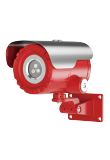
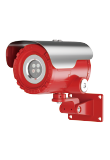
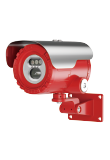

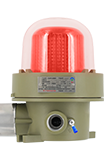
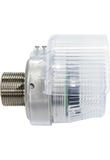
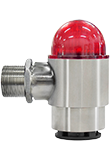

With a flange leak, an open flame can go from ignition to burning through a pipeline in just minutes. During those minutes, smoke detectors are still waiting for smoke to drift over, heat-sensing elements are still waiting for the temperature to climb—while the flame has been radiating light at specific wavelengths since the very first second. What a flame detector must do is convert that light into an alarm within that window.
How Flame Detectors Work
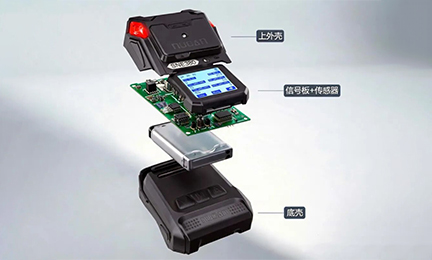
Flame radiation energy is concentrated primarily in the infrared and ultraviolet bands, and different physical effects determine the detection mechanism and applicable boundaries of each detector type. Currently, mainstream industrial flame detection solutions fall into three categories: infrared characteristic-band detection, ultraviolet plasma detection, and dual-band fusion technology. A fixed flame detector internally consists mainly of a four-stage series signal chain.
The first stage is the optical window: quartz material transmits flame radiation while keeping out dust and water.
The second stage is the narrowband filter, which passes several characteristic spectral lines at 3.8 μm, 4.3 μm, 4.4 μm, and 5.0 μm; the ultraviolet channel, meanwhile, operates in the 185–260 nm “solar-blind” region.
The third stage is multi-channel sensing: one main detection channel plus several reference channels.
The fourth stage is the characteristic algorithm: a real flame has a distinct flicker frequency, and the main channel and reference channels exhibit a specific ratio—sunlight, welding arcs, and hot bodies cannot simultaneously satisfy these criteria and are rejected by the algorithm. In other words, immunity to false alarms depends mainly on the number of channels and the algorithm design. For example, four-infrared (IR4) adds one more reference channel than three-infrared, and a combined infrared/ultraviolet design layers on an additional ultraviolet criterion, which also covers hydrogen, methanol, and other non-hydrocarbon pale-blue flames.
Five-Layer Early Warning Architecture
A single-point detector does not equal early warning capability—industrial-grade systems must connect all five layers.
The perception layer places detectors so that their fields of view cross-cover one another, with adjacent detectors overlapping by more than 15% to eliminate blind spots caused by pipes and supports. The transmission layer connects via 4–20 mA, RS485 Modbus, or the fire alarm bus. The control layer relies on the fire alarm control panel to complete “alarm → interlock” in a single step. The platform layer handles verification, tiered notification, and event traceability.
The most easily overlooked factor in selection is the output interface: whether relay dry contacts, 4–20 mA, RS485, and the fire alarm bus are all available directly determines whether a detector can connect to both the fire protection system and the DCS. A interface mismatch makes later retrofits far more costly than any price difference at purchase.
Selection Guide
Technology Mapped to Application
The operating principle of infrared flame detectors centers on capturing the characteristic carbon dioxide emission peak released during the combustion of hydrocarbons; paired with narrowband optical filters, this effectively isolates background thermal radiation, delivers excellent response linearity, and provides strong resistance to sunlight interference, making it suitable for monitoring slow-spreading fires. Ultraviolet solutions, by contrast, exploit the nanoscale ultraviolet photons generated by high-temperature flame plasma, converting them directly into an electron current via a photocathode. This physical mechanism gives them extremely fast transient response—but also makes them highly sensitive to welding arcs, lightning, and high-altitude ultraviolet transmission. A comparison of the physical characteristics of infrared and ultraviolet solutions shows that a single spectral channel can no longer meet the false-alarm suppression requirements of complex industrial sites, and dual-band cross-validation has become the engineering standard.
Parameters Mapped to Operating Conditions
Detection range × sensitivity level: GB 15631-2008 specifies 25 m for Class I, 17 m for Class II, and 12 m for Class III. A nominal 50 m rating (against a 0.3 m × 0.3 m n-heptane fire) does not mean reliable detection at 50 m on site—it must be derated for obstruction, smoke, wind, and flame type. For tall, open spaces, long-range models should be preferred to reduce the number of installation points.
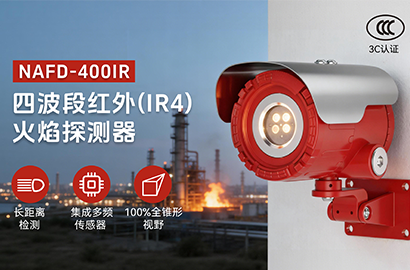
Field of view × number of installation points: a 90° full-cone field of view, ±45° from the central axis; signal attenuates at the edges of the field of view, so installation points must be laid out with overlap in reserve.
Response time: ≤30 s is the typical response value under fire protection codes, but actual performance varies considerably—specific values should be requested from the manufacturer.
Environmental adaptability: -40 to 70 °C and IP67 for northern outdoor and washdown locations; Ex db IIC T6 Gb / Ex tb IIIC T80 °C Db for combined gas and dust explosion protection; SS316 enclosures for coastal and high-hydrogen-sulfide locations.
Certification verification: point-type flame detectors are listed in the compulsory product certification (CCC) catalogue—verify that the certificate number, certification unit, and purchased model match and that the certificate is within its validity period. The Ex marking on the explosion-proof certificate must match the site’s gas group and temperature class; for export projects, IECEx must also be verified. SIL functional safety and EMC certifications should be treated as technical scoring items in tenders, and the corresponding test reports should be requested as well.
Nuoan Technology Flame Detector Selection Guide
| Model | Detection Principle | Spectral Range | Application Scenarios |
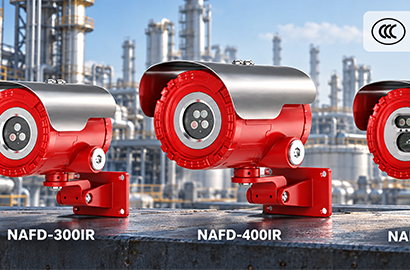
| NAFD-300IR | Three-band infrared (IR3), 1 detection + 2 reference channels | 3.8 / 4.3 / 5.0 μm | General petrochemical indoor and outdoor process units; the cost-effective choice |
| NAFD-400IR | Four-band infrared (IR4), 1 detection + 3 reference channels | 3.8 / 4.3 / 4.4 / 5.0 μm | Dense process units with heavy welding, intense light, and thermal radiation interference |
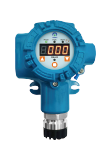
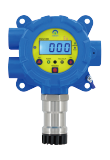
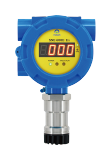
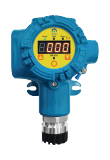
All three models share the same “chassis”: field-adjustable sensitivity levels I–IV, response <30 s, 50 m @ 0.3 m × 0.3 m n-heptane fire, 90° full-cone field of view, IP67, -40 to 70 °C, and Ex db IIC T6 Gb / Ex tb IIIC T80 °C Db weatherproof and explosion-proof design; output options cover relay dry contacts, 4–20 mA, RS485 Modbus, and fire alarm bus; aluminum alloy or SS316 enclosure available.